- INTERFACE TYPE
- Workflow
- INDUSTRY
- Healthcare
- AGENCY
- GoInvo
- PROJECT STAGE
- Not independently confirmed
The problem and context
Maya Healthcare, based in Texas, wanted an electronic health record (EHR) for home-health agencies. GoInvo reports that it designed the service with a team of two designer-engineers over six months and later provided engineering support to help ship it. GoInvo’s original account.
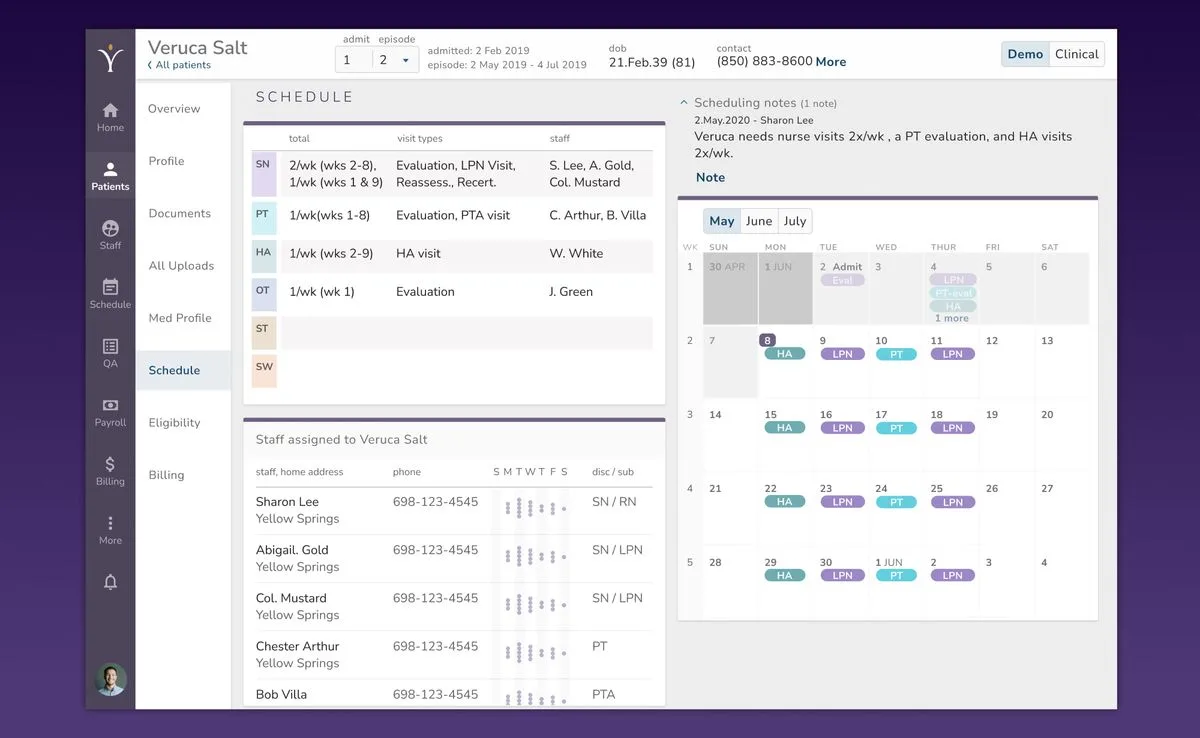
The agency frames the market problem plainly: large EHR products are too expensive for the thin margins of home care, and they are not built for nurses working in patients’ homes. The product had to be “part traditional EHR, part fleet management system, part content management system”: clinical records, plus the logistics of sending staff to many homes every day.
The constraints
- Scheduling is regulated and unforgiving. GoInvo notes that staff are only paid when schedules comply with regulations, sometimes within very small appointment windows.
- Care happens on the move. Nurses switch between laptops and phones, often out of cell range.
- A small budget. GoInvo explicitly describes balancing ideal designs against a shoestring budget and timeline.
Design decisions worth examining
1. Start with intake and scheduling
GoInvo’s stated principle: “If you can’t schedule 50 nurses and 1,000 patient visits, the clinic collapses.” The team designed patient intake and scheduling first, before the wider record. GoInvo’s original account.
Our reading: this is a sound order of work for a budget-constrained EHR. Incomplete intake data breaks both care and billing later on, and scheduling is where daily operations fail first. Getting these right creates the foundation every later screen depends on.
2. Show schedulers what needs doing next
The research findings call for clear visibility of which patients need appointments next and what each appointment requires, plus an overview of clinical staff credentials, location, and availability. GoInvo’s original account.
Our reading: this turns scheduling from a calendar problem into a matching problem: the right credentialed nurse, near the patient, inside the compliant window. An interface that surfaces those three facts together reduces the mental juggling a scheduler does today.
3. Carry documentation forward instead of starting over
GoInvo describes patients having several assessments and plans of care, one per discipline and time period. The tool consolidates these and draws on past documentation when nurses write new plans, so paperwork does not start from zero. Key documents can be signed on the spot. GoInvo’s original account.
Our reading: reusing earlier documentation cuts the time nurses spend on paperwork. It also carries a known risk: copied-forward text can preserve outdated information. The published material does not show how changes from the previous plan are highlighted.
Contribution, outcomes, and evidence
Documented contribution: research with back-office and field staff, end-to-end workflow design, interface design, and engineering support toward release, per GoInvo. Maya Healthcare owns and operates the product.
Stage: GoInvo states that the software shipped and is “now in the field”, with scheduling, billing, payroll, nursing notes, digital consent signatures, patient profiles, and quality assurance. This is the agency’s account; we have not confirmed current deployment or the number of agencies using it.
What we did not verify: no independent regulatory, compliance, or clinical-safety review is implied. Feature descriptions come from GoInvo; “Our reading” passages are our interpretation.
A practical lens
- Find the workflow whose failure stops the business, and design it first. In home health that is intake and scheduling.
- Present matching problems as matching problems. Put the constraints (credentials, location, time window) side by side.
- Design for patchy connectivity from day one when users work in the field.
Where this may not transfer: home health has many visits, many travelling staff, and strict scheduling rules. A hospital ward or outpatient clinic has a different bottleneck, such as handover between shifts or patient flow.
Original source and editorial responsibility
Source: GoInvo’s original account, checked 16 November 2026. Written by Best UX Portfolios from the agency’s published case study and images. We have not used the product or interviewed Maya Healthcare. Spotted an error? Request a correction.